Querétaro, Mexico
This week I got back into the language groove. Since I began teaching English, my own language learning (Japanese & Spanish) completely fell to the wayside…
But, just because I’m focusing on one goal doesn’t mean my progress in others should stagnate — or worse, deteriorate. It seems like there’s never enough time to do it all, but something (anything) is always better than nothing.
Now that I’ve been on both sides of the student-teacher fence, I see with clarity that forgetting is a huge part of learning. This might seem counterintuitive, but hear me out.
If you’ve ever learned anything, you’ll recall the frustration that comes with it. Wracking your brain for the solution to a math problem you studied over and over or not being able to remember a key word or phrase. It feels like your brain is a leaky bucket! We often tie these moments of forgetfulness to failure. “Why can’t I remember this? I feel so stupid.” To make it worse, struggling to perform well in public and under pressure compounds the embarrassment.
When we think about learning, we often imagine progress as a straight upward climb. In language that equals: more vocabulary, more grammar, more fluency everyday. If only that was the case! In reality, learning is more like a spiral. As you loop back (forgetting) you might feel like you’re right where you began… Except now, just like on a spiral staircase, you’re a little higher than you were before. You loop back, you forget, and then you relearn.
Science also proves that forgetting isn’t failure — it’s the brain’s way of reinforcing what matters. When you forget a word/concept and then encounter it again later, your brain makes a stronger connection than if you had remembered it perfectly the first time. This phenomenon is called spaced repetition. If you’ve ever used Anki, a flashcard application, you’ll have heard of it.
Cramming before a test (a tactic we’ve probably all employed at some point…) might feel like an effective strategy. This idea is formed during our youth. To succeed in school you only need to remember something long enough to pass that next exam. After that, the brain does a big ram dump.
During the 1800’s, psychologist Hermann Ebbighaus discovered the Forgetting Curve:
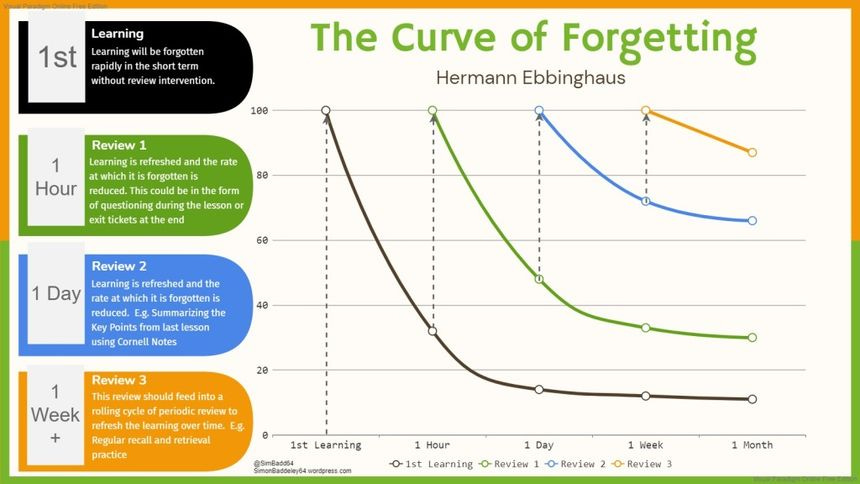
His studies show how quickly we forget things if we don’t reinforce them frequently in the beginning. As opposed to saying a new word 100 times over, quizzing yourself a few times in the span of a day will be more effective for memorization. Each time you successfully recall it, the ‘spacing’ between reviews should get longer. Every review flattens the curve and strengthens retention.
As children, we experience this naturally. Babies learn words with constant repetition from their families and the world around them. Some homeschooling parents I know take this to an even higher level. Learning is much easier for kids (or anyone for that matter) if we apply it to real life. I’ve seen children as young as 5 being taught basic science in the form of a cooking/baking class or on a daily walk in nature. When they’re playing outside they talk about the names of the plants and what their uses are. The next time they eat a slice of bread they recall the chemical reactions it took to create it. In this way, learning is tied to their tangible world — creating natural ‘spaced repetition’ in every aspect of their day. Immersion is key.
This is especially true with language learning. I see it in my own students. Our interactions are limited to an hour, so how can I help them achieve this? Most of them don’t live in English speaking countries, so I recommend creating their own immersive environment. For example, I’ve been working on present tense grammar and household vocabulary with a 7 year old student. When she helps her mom in the kitchen, she creates present tense sentences with words like pot, utensils, cabinet, and refrigerator. Each class we review what we learned last class. Of course she doesn’t remember it all the first go around, but after a couple classes she’s chirping away!
The same is true for my adult students. Some of them are able to reinforce new words and structures in the workplace, while others use flashcards or consume English media.
You could also think of this repetition as paving a trail in the forest. The first time, you barely see the path. The second time, the weeds are thinner. The third and the fourth, the path is beginning to clear. The more often you walk your new path the longer it takes for vegetation and foliage to take over again.
For my own language learning, I’ve been using Anki for a couple years now, and it helps me target my weaknesses. I'm also fortunate enough to have native Japanese and Spanish speakers around me.
So, next time you forget a word or concept you thought you knew, instead of feeling frustrated with yourself, just go back and refresh your memory. You don’t need to be a genius, you need commitment. Climb the spiral staircase. Clear the path.
Forgetting is not the opposite of learning — it is learning.
Language
Japanese: 1 hour, 6/7 days
My mom is home from work, so I’ve gotten a lot more passive practice throughout the day with her. On top of that I committed to at least an hour most days of dedicated studying.
Some resources I recommend are:
‘NHK News Easy’ This website is specifically made for Japanese learners by the broadcasting company, which I really respect.
‘Tanaka Radio’ A youtube channel that talks about all sorts of things.
‘JLPT Sensei’ I use this mainly for kanji study. Beware, JLPT is not 100% accurate for daily Japanese conversation.
‘Jisho.org’ Best. Japanese. Dictionary. Ever.
Spanish: 1 hour, 4/7 days
It’s been interesting coming back to Mexico from Uruguay. The accent is very different and so are some words. I’ve decided not to try and adapt to the Mexican accent and instead just confuse people even more when pronounce the letters ‘y’ and ‘ll’ as ‘shh’ instead of with a ‘yuh’ sound. Plus, it makes for a good conversation starter when people ask me if I learned Spanish in Argentina!
Some resources I recommend are:
‘Spanishdict’ Same as the dictionary above. I avoid Google Translate like the plague.
‘Español con Juan’ These videos are easy for me to put on while I do other things and get some listening practice in. Although his speech is incredibly clear and easy to understand, which unfortunately is usually not how it is in real life… (FYI, he speaks Castilian Spanish.)
I’ve also been watching cello videos to make classes and communication with my teacher easier.
Cello:
I really enjoyed class again this week. I’ll go over the details more in a future post, but I definitely need to start building more strength. My shoulders and hand muscles I didn’t even know I had are sore…
It’s looking like I won’t be here in Querétaro for much longer. The teacher I have here is great, so I’m going to pack in as many classes before leaving as possible. I’ll start looking at lessons to continue learning back in Uruguay soon.
Writing:
Mall Cop Authority

If you’ve been in a mall, chances are you’ve seen them: the mall cops. Armed with a badge, a radio, and maybe even a Segway…
Reading:
Finished ‘The Market for Liberty’ by Morris and Linda Tannehill:

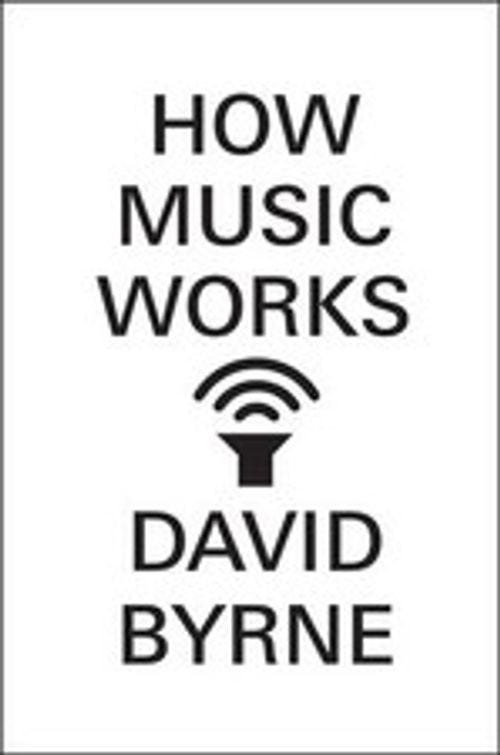
Started ‘How Music Works’ by David Byrne:
Started ‘Richard II’ by William Shakespeare: