

2026/01/27 [Osaka, Japan]
It’s good to finally get going! Every day this past week, I commuted an hour and a half to Kyoto to learn about textiles and traditional silk weaving.
Japanese goods are known for their careful construction, high-quality materials, and attention to detail. Seeing how those elements are created directly in a textile workshop has been very interesting. This way of production is very different from how clothing (or most anything else) is produced today. Modern garments are designed for speed and volume, which is part of why so many pieces wear out quickly or lose their shape after only a short time.
Goods were once made with durability in mind, since most people didn’t have the resources to buy replacements every other week. Materials were chosen carefully, techniques were refined across generations, and the process itself encouraged longevity. While there were innumerable benefits that came from the industrial revolution, the average quality of products and craftsmanship has taken a nosedive.
Even in my first week of learning Tsuzureori, it’s clear that this craft values patience and precision over efficiency—and that difference fundamentally changes the quality of what is made.
An Unexpected Teacher
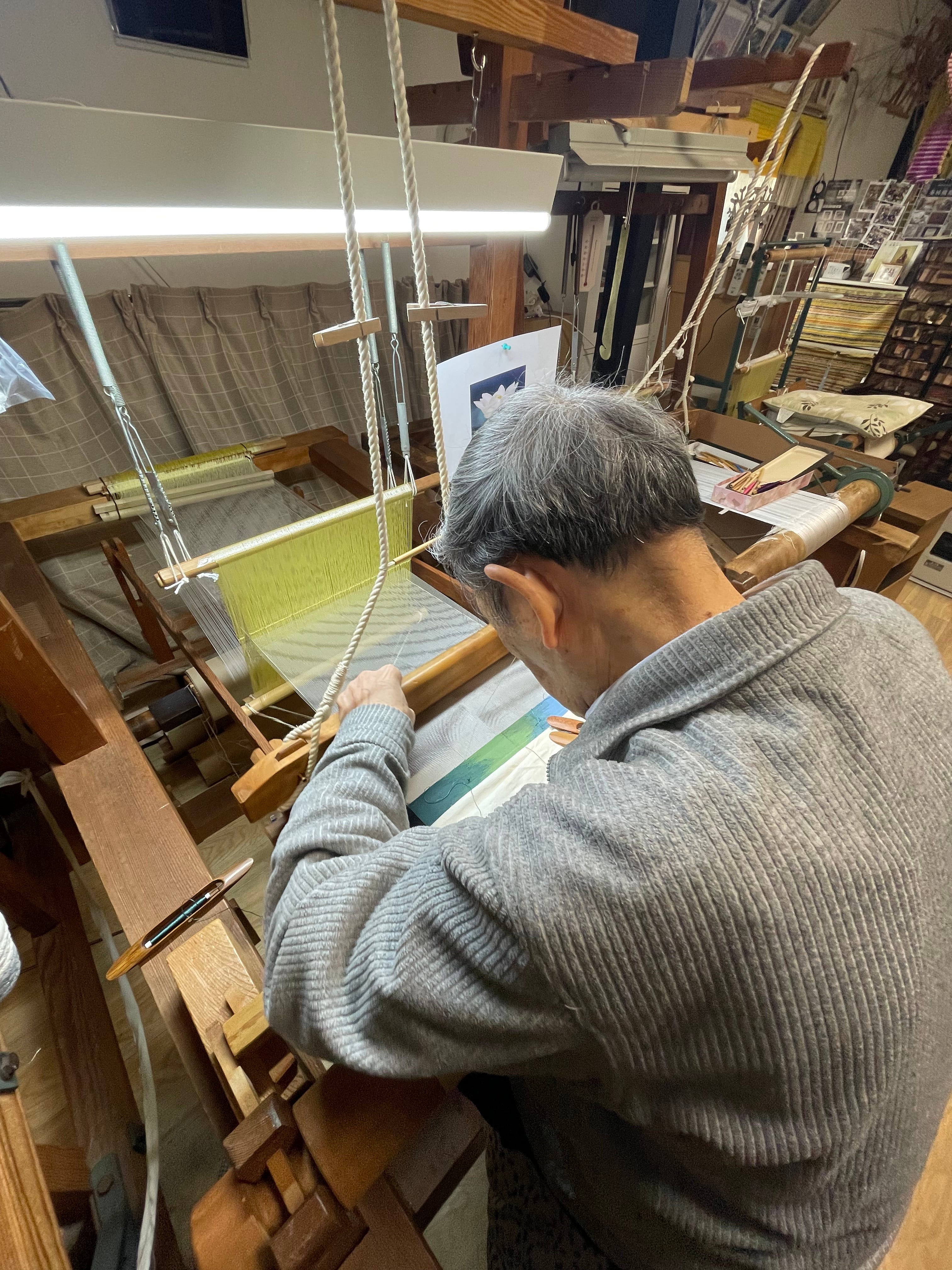
What I didn’t realize when I first contacted this studio was that my teacher would be Hirano-san, someone I would truly consider a master of his craft. Hirano-san has been working in silk weaving since childhood.
Since both of his parents were silk weavers, he, his brother, and his four sisters were raised in an environment of workshops and continual production. Of all his siblings, Hirano-san was the only one who continued the craft into adulthood. Over the years, he worked in many different studios, learning from masters of his generation and refining his technique.
And in his 70+ years in weaving, a handful of pieces that he and his teams produced are now held and displayed in museums across Japan. He doesn’t advertise these facts, and it was only after a few days of getting to know him that I realized how fortunate I was to happen upon his studio.
Despite (or maybe because of) his experience, his teaching is patient and precise. He can be strict and particular, but that discipline is what makes his works possible.
More Than Age
One thing that has stuck out to me since moving away from the US is how active people are in other countries. In Uruguay, every little town has a long paved walking path. Coastal cities have ramblas where you see friends and families strolling along with their mate (traditional herbal tea). Seniors in Asian countries have always seemed active to me, but a recent ski trip really raised the bar. This is a generalization, but if I asked most people back home above the age of 60 (maybe even 50) if they ski, they would look at me like I was insane.
Now there I was, never having skied before, like a bambi learning to walk wobbling down bunny slopes. Experienced skiers wizzed by me with lightning speed and stopped gracefully at the bottom. When I finally caught up, although I couldn’t see their faces, by their voices I could they all must’ve been above the age of 70.
Flash forward to the other day. Hirano-san had me doing all sorts of small tasks around the studio, and that afternoon I was completely focused on splitting and winding thread onto spools. Suddenly, I heard drilling. When I turned around, Hirano-san was standing on top of my large wooden loom, installing new hardware as if it were nothing.
Working with traditional machinery involves a constant amount of setup and adjustment, and he moves through that work without hesitation — crouching, climbing, and crawling underneath the loom whenever something needs attention. Watching him move so dexterously at his age is impressive. It reminds me of my great-aunt, who is still sharp as a nail and quick as a whip at 102, in part because she continues to play the piano every day.
It also brings to mind a book I read last year, Ichigo Ichie, which talks about blue zones (small regions where people tend to live noticeably longer) and the habits that support that kind of longevity. One of the recurring ideas is the importance of having a purpose and staying engaged. My new teacher is living proof of this. Silk weaving isn’t just a career, it’s a passion that keeps him moving, problem-solving, and motivated every day. I’m sure a large part of it is genetics, but I hope that that kind of dedication is something I can carry into the future.
Passing Time
Surprise! Spending 3 hours on trains every day isn’t all that fun. While the long commute isn’t great, it gives me designated time for reading and academic course work, which has been helpful.
I’m over halfway through Understanding Japan: A Cultural History and it’s remained interesting. Getting a better perspective on Japan’s timeline has made me realize how certain short eras are magnified, while longer periods are often reduced or simplified. Isolation and constant samurai warfare dominate the mainstream image of the country’s history, even though those periods were relatively brief.
Aside from the course and daily language practice:
Finished: Hagakure by Yamamoto Tsunetomo

Started: The Book of Tea by Kakuzo Okakura

Room for Improvement
I’m about as forgetful as ever. Being scatterbrained wastes a lot of time.
I’ve been tempted to listen to music or a podcast while weaving, but thinking on it I shouldn’t. First, that would impede on the process itself. Although it can be tedious, it takes lots of brainpower to create a design that any unnecessary noise would take away from. Second, listening to stuff constantly is bad for my brain. Having a 6 hour daily hiatus is probably doing me some good. Maybe I can use that time to stop being so forgetful…
Here’s to more progress next week! - Morgan Senna
What you're doing is so amazing. I hope to follow in your footsteps in one way or another.
I’m very grateful I found your work
Your writing flows, and for a moment I was transported in the workshop. Did you already have a base in Japanese or had to learn it from scratch?